
Two different worlds, a few feet apart
There was a breeze in the garden today. Under the trees, it felt pretty damn good.
Then I stepped out into the direct sunlight.
Fucking scorcher.
The change was immediate. Not gradual. Not something I needed an instrument to confirm. Under the canopy, the shade and moving air made the garden feel livable. A few feet away, the sunlight felt as if somebody had opened an oven door.
That contrast is one of the things this garden keeps teaching me. “Full sun” and “shade” sound like simple labels on a plant tag. Out here, they are entirely different environments. The same yard can contain several climates at once—cooler beneath the trees, hotter beside a wall, wetter near one bed, and bone-dry only a few feet away.

Some plants droop in the afternoon and recover later when the sun moves, clouds arrive, or the evening cools things down. That doesn’t always mean they need another blast from the hose. I’m learning to check the soil and watch what happens over several hours instead of panicking every time a leaf looks miserable. Plants can be dramatic little bastards, but sometimes they have a legitimate complaint.
The trees are doing more than making the yard attractive. They are a living roof. They shade the ground, hold moisture longer, soften the sunlight, and create places where both plants and people can get some relief.
The trees aren’t decoration. In July, they’re infrastructure.
This probably seems obvious. Trees make shade. No shit. But knowing something and physically walking through it are two different things. Step from beneath a mature canopy into exposed Florida sun in July and the lesson becomes immediate.
It also makes me think about how much cooler our neighborhoods—and the planet—could have been if we hadn’t cut down so many motherfucking trees and covered so much ground with concrete.
I’m not trying to turn this into a lecture. This is a garden journal, not a manifesto. But the garden keeps connecting small observations to larger ones. A breeze under a tree becomes a lesson in microclimates. A bed of drooping plants becomes a reminder that placement matters. A patch of shade becomes infrastructure.
That is what the heat reveals. Not every part of the garden is experiencing the same July—and neither are we.
Garden experiment
Cowpeas Doing More Than Growing Peas

The Pinkeye Purple Hull cowpeas are growing in the same bed as the melons, roughly a foot or more away. I planted them partly because they can produce food and partly because they may help me rebuild this sandy Central Florida soil.
Cowpeas are legumes. With the right bacteria working around their roots, they can fix nitrogen. That does not mean they are little fertilizer dispensers automatically feeding every plant beside them. Much of the benefit may come later, especially as roots and plant material break down. This is an experiment, not a victory speech.
What I can see right now is growth. The cowpeas are filling space, covering some exposed soil, and surviving conditions that make less heat-tolerant plants reconsider their career choices.
I’ll be watching for flowers and pods, how much they spread, whether they compete with the melons, and what happens to the bed after the cowpea season is over. If they give me peas, protect the soil, and contribute something useful below ground, that is a pretty good return from one planting.
Photography field note
Looking for the Picture in the Lantana

I spent some time photographing the lantana growing around the greenhouse. The flowers are already attractive, but an attractive subject does not automatically make an interesting photograph.
So I moved around. I changed the angle, watched the background, and tried to find a composition instead of merely making a record that says, “Here is some lantana.”
Digital photography makes this easy in one sense. I can take twenty frames, fifty frames, or more without hearing the ghost of a 24- or 36-exposure roll asking what the hell I’m doing. But more chances do not necessarily mean better seeing. They can just produce more mediocre photographs to sort through later.
The garden gives me subjects every day. Flowers, damaged leaves, insects, textures, shadows, new growth, old growth. The real work is deciding what the photograph is about—and what does not belong in the frame.
Field tool
Sun Surveyor Lite: Stop Guessing
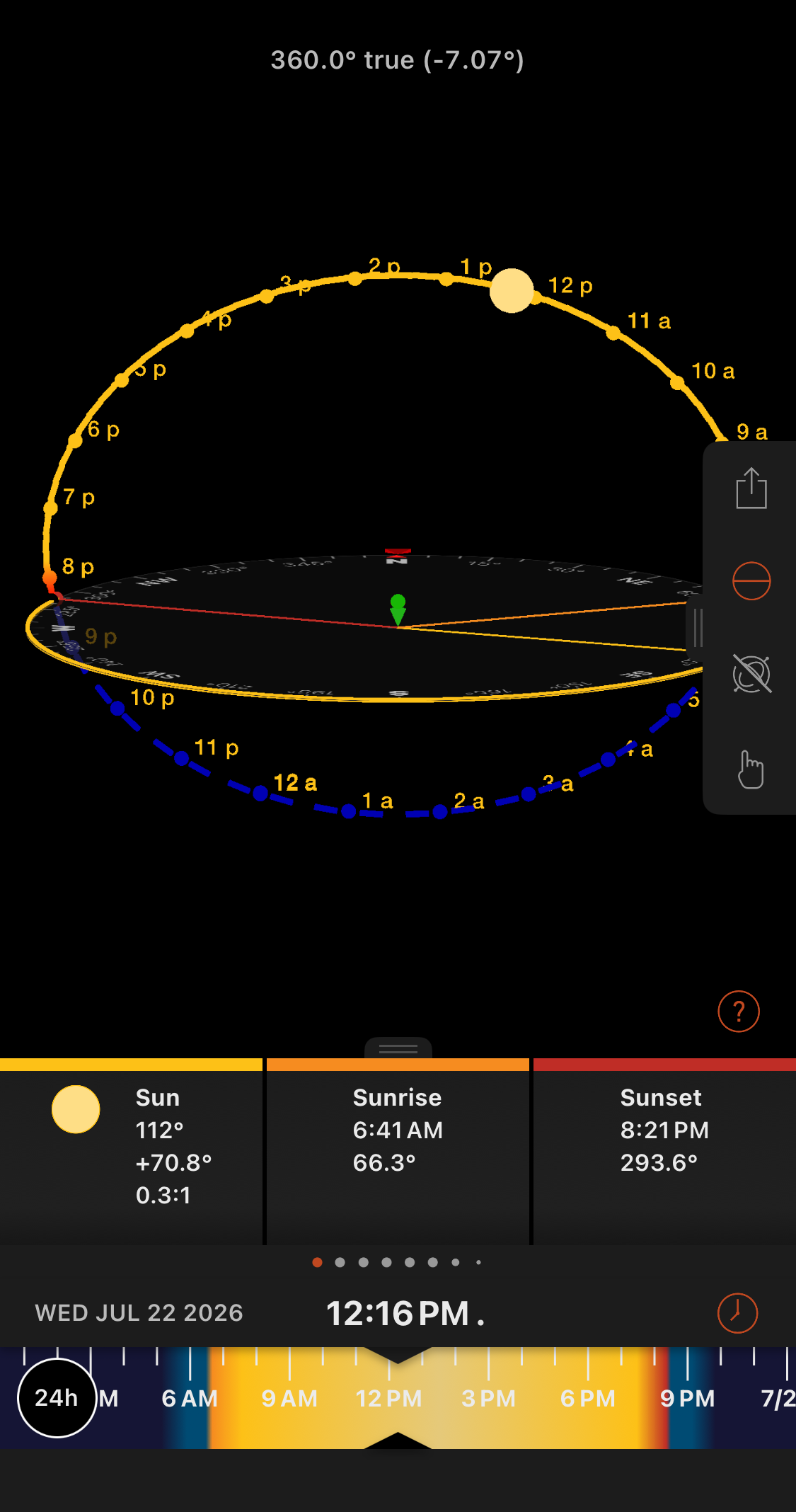
I use Sun Surveyor Lite to see where the sun will be at different times of the day—and during different seasons of the year. That is useful when deciding where to place a bed, whether a plant is really getting “full sun,” or how much the shade will shift as summer turns toward fall.
The phone’s regular compass tells me direction. Sun Surveyor Lite tells me where the sun fits into that direction. It does not make the decision for me. It simply helps me stop guessing—which, in a garden, is already a hell of an improvement.
What’s growing now
Still Growing in Hell Month

July does not stop the garden. It changes the cast.
Melons and cucumbers
The vines keep moving through the beds while I watch the heat, rain, and wildlife. A fruit can look promising one day and become somebody else’s lunch the next. Nothing is officially mine until it reaches the kitchen.
Moringa
I cut the moringa way back, and it appears to have treated that as a suggestion. It is growing strongly again. Some of the older growth has dark, rough texture that caught my eye. I’m documenting it without pretending I know exactly what caused it. Sometimes the first job is to notice—not diagnose from across the yard.
The larger picture
Some plants are producing. Some are recovering. Some are drooping at midday and standing again by evening. Others may be telling me they are simply in the wrong place.
That is the July garden: not dead, not thriving uniformly, and certainly not posing for a seed catalog. It is adjusting in real time.
Looking ahead
The garden gets the last word
For the rest of July, I’ll be watching for flowers and pods on the cowpeas, how the melons handle the combination of heat, rain, and hungry visitors, which beds hold moisture, and which ones bake dry. I’ll also keep watching the moringa continue its aggressive return.
The garden will decide what the next story is. It usually does.